
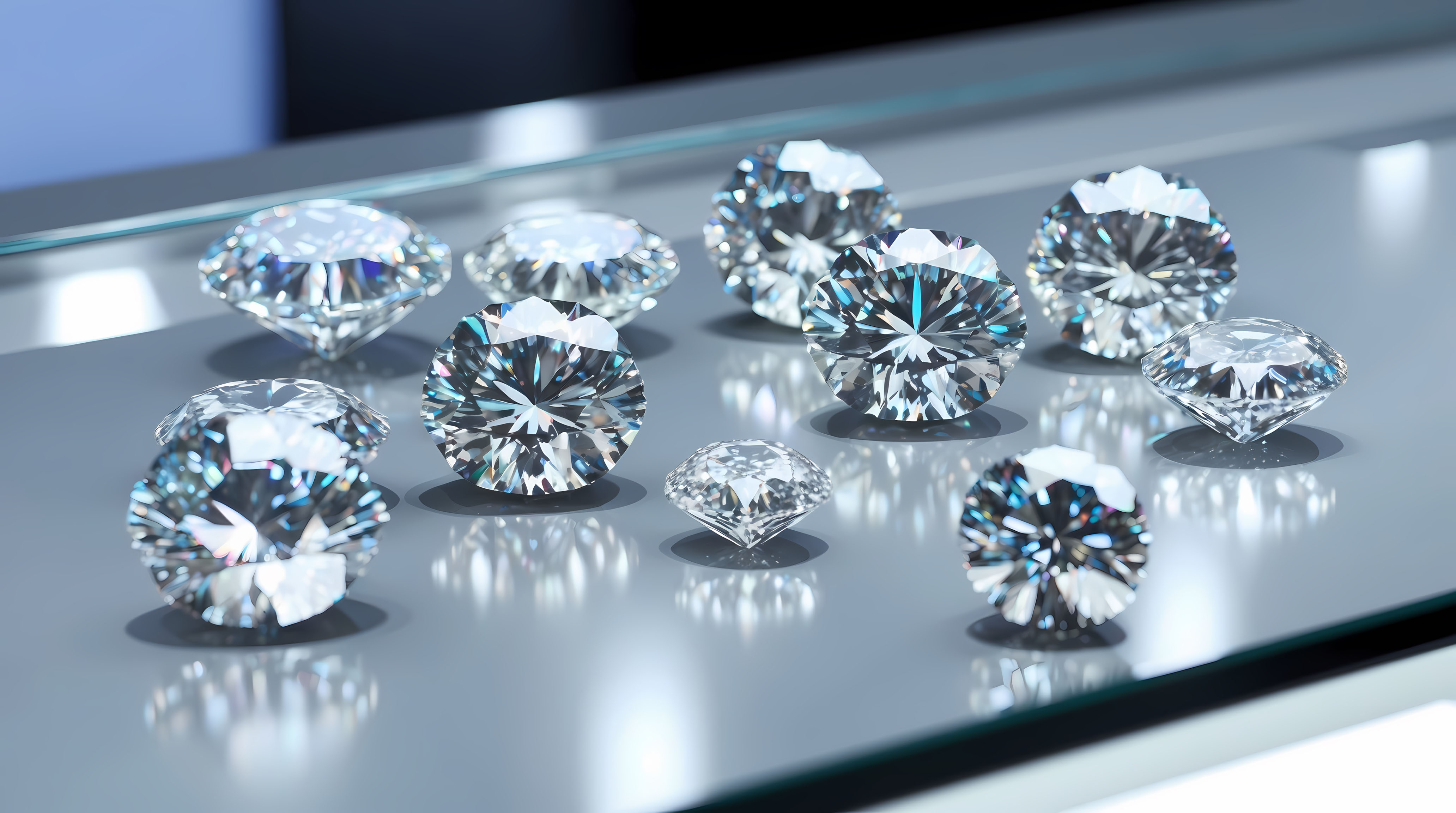
If you're shopping for a diamond — or just curious about the buzz — you've probably run into the term "lab-grown." Maybe a friend mentioned it. Maybe you saw the price difference and did a double-take. Or maybe you're simply wondering: are these things actually real?
You're not alone. Lab-grown diamonds have gone from niche curiosity to mainstream choice in just a few years. In 2025, they accounted for 61% of all loose diamond engagement ring sales in the U.S. — up from just 2% in 2017. That's a seismic shift.
But with popularity comes confusion. So we've rounded up the 10 most-asked questions about lab-grown diamonds and answered each one clearly, honestly, and without the sales pitch. Whether you're ring shopping, gift hunting, or just diamond-curious, this is your starting point.
Let's dive in.
1. Are Lab-Grown Diamonds Real Diamonds?
Yes — unambiguously.
Lab-grown diamonds are made of pure carbon atoms arranged in the same crystal structure as natural diamonds. They have the same chemical composition, the same optical properties (brilliance, fire, scintillation), and the same physical hardness — a perfect 10 on the Mohs scale.
To the naked eye, they are indistinguishable from mined diamonds. Even a trained jeweler needs specialized equipment — like a UV lamp or spectroscopy device — to tell them apart. The only reliable way to know a diamond's origin is through a laboratory certificate.
Think of it this way: ice made in your freezer and ice from a glacier are both ice. The origin story differs; the substance doesn't.
2. How Are Lab-Grown Diamonds Made?
There are two primary methods, both of which replicate the extreme conditions that form diamonds deep within the Earth — just faster.
HPHT (High Pressure High Temperature): This method mimics the Earth's mantle, applying pressures of 5–6 GPa and temperatures of 1300–1600°C to dissolve carbon in a metal catalyst, which then crystallizes onto a diamond seed. Growth can take anywhere from an hour to several weeks.
CVD (Chemical Vapor Deposition): This method uses lower pressure (below 1 Pascal) and temperatures of 700–1300°C. Carbon-containing gases — typically methane — are activated by plasma and deposit carbon atoms layer by layer onto a diamond seed. CVD is well-suited for growing larger, higher-purity crystals.
Today, most lab-grown diamonds submitted to gem labs are made using CVD, and many undergo post-growth HPHT treatment to remove unwanted color.
3. Can You Tell the Difference With the Naked Eye?
No. Once polished, lab-grown and natural diamonds look identical. Both exhibit the same sparkle, fire, and brilliance. What determines how a diamond looks is cut quality — not its origin. A poorly cut natural diamond will look duller than a well-cut lab-grown one, and vice versa.
The only visible difference you'll find is on the certificate, not on the stone itself.
4. Are Lab-Grown Diamonds Cheaper? By How Much?
Significantly cheaper — and the gap is widening.
Here's how the numbers stack up:
| Comparison | Lab-Grown Diamond | Natural Diamond |
|---|---|---|
| 1 carat, F-VVS (India retail) | Approx. ₹45,000 | Approx. ₹7.5 lakh |
| 1.5 carat, Oval VS1 (U.S. retail) | From approx. $1,000 | From approx. $8,000 |
| 1 carat, E/VVS (UK retail) | £800–£2,000 | £4,500–£8,500 |
Broadly speaking, lab-grown diamonds cost 30–70% less than natural diamonds of comparable quality — and in some categories, the difference reaches 80–90%. The larger the carat, the bigger the gap.
Why? Because lab-grown diamonds can be produced at scale. As production capacity has expanded, wholesale prices have fallen 93% since 2020, to around $100 per carat. Natural diamonds, by contrast, are geologically finite — formed over 1–3 billion years — and their supply is constrained by mining economics.
5. Do Lab-Grown Diamonds Hold Resale Value?
Practically speaking, no.
The Jewelers Association of Australia (JAA) has stated plainly that lab-grown diamonds have an "intrinsic value effectively of zero" — meaning their resale value is essentially just the value of the metal setting. Because they can be manufactured indefinitely, they behave like consumer products, not scarce assets.
That said, here's a nuance worth understanding: the absolute loss is often smaller with lab-grown.
Consider a 1.5-carat comparison:
| Natural Diamond | Lab-Grown Diamond | |
|---|---|---|
| Purchase price | $10,000 | $1,800 |
| Resale recovery rate | 35% | 15% |
| Resale amount | $3,500 | $270 |
| Actual loss | $6,500 | $1,530 |
Natural diamonds recover a higher percentage — but because the purchase price is so much higher, the cash loss is far greater. If you never plan to resell, lab-grown wins on pure cost efficiency. If resale liquidity matters to you, natural diamonds still have a functioning (if imperfect) secondary market.
Bottom line: Buy a lab-grown diamond to wear and enjoy — not as an investment.
6. Are Lab-Grown Diamonds Certified?
Yes — but the certification landscape is shifting.
IGI (International Gemological Institute) remains the practical industry standard for lab-grown diamonds, applying the full 4 Cs (cut, color, clarity, carat) just as it does for natural stones. Its position is that consumers deserve full transparency.
GIA (Gemological Institute of America), long the gold standard for natural diamonds, changed course in October 2025. It stopped using the 4 Cs for lab-grown stones and replaced them with a simplified "Premium" or "Standard" two-tier description, effective February 2026. GIA's reasoning: more than 95% of lab-grown diamonds fall within an extremely narrow quality range, making detailed grading less meaningful.
What this means for you: Always buy with a certificate, and know which lab issued it and what standard was applied. A "Premium" GIA label means something different from a full IGI 4 Cs report.
7. Are Lab-Grown Diamonds Eco-Friendly?
Generally yes — but the picture is more nuanced than marketing suggests.
Compared to mining, lab-grown diamonds have a significantly lighter footprint:
| Metric (per carat) | Lab-Grown | Natural (Mined) |
|---|---|---|
| Water consumption | 18.5 gallons | 128 gallons |
| Energy consumption | 36 kWh | 80 kWh |
| CO₂ emissions | As low as 0.028 g (renewable energy) | Up to 57,000 g |
That's roughly 86% less water and 55% less energy per carat. Pandora has disclosed a carbon footprint of 12.58 kg CO₂e per carat for its lab-grown diamonds, claiming about 90% lower emissions than mined equivalents under specific renewable-energy production.
The caveat: Not all labs run on clean energy. A lab-powered by a coal-heavy grid will have a much larger footprint than one using solar or hydro. If sustainability is your priority, ask the retailer about their energy source — "lab-grown" alone doesn't guarantee "green."
8. Will Lab-Grown Diamonds Last Forever? Do They Turn Yellow?
They last forever — and modern stones do not turn yellow.
Lab-grown diamonds are real diamonds, with a Mohs hardness of 10. They are scratch-resistant, durable, and will not degrade over time. They can be worn daily, cleaned, and passed down just like natural stones.
The "turning yellow" concern comes from early-generation CVD diamonds, some of which had color stability issues. Modern production — especially with post-growth HPHT treatment — has largely resolved this. Today's lab-grown diamonds are color-stable under normal wear conditions.
As with any diamond, proper care (regular cleaning, avoiding harsh chemicals) keeps them looking their best.
9. Are Lab-Grown Diamonds Conflict-Free?
Yes — inherently.
Lab-grown diamonds bypass mining entirely, which means they are free from the labor abuses, environmental destruction, and conflict-financing concerns associated with some natural diamond supply chains. Even with the Kimberley Process and other certification schemes, traceability in natural diamond supply chains remains imperfect.
For buyers who prioritize ethical sourcing, lab-grown offers a clear advantage: there is no mine, no excavation, and no conflict footprint. The ethical question shifts from "where was it mined?" to "how was the lab powered?" — a different, but more transparent, conversation.
10. Should You Buy Lab-Grown or Natural?
There's no universal right answer — only the right answer for you.
Here's a simple framework:
Choose lab-grown if you:
-
Want a larger or higher-quality stone for the same budget
-
See the diamond as a consumer purchase for wearing, not investing
-
Value environmental and ethical attributes
-
Are comfortable with near-zero resale value
Choose natural if you:
-
Value geological rarity and the "billions of years" story
-
Want better resale liquidity (even if returns aren't guaranteed)
-
View the diamond as a long-term heirloom or milestone symbol
-
Are willing to pay a significant premium for natural origin
Both are real diamonds. Both sparkle. The difference is in the value logic — and that logic should match your own priorities, not someone else's sales pitch.